If you have ever wondered why one part of Highlands Ranch feels easier for your routine than another, you are asking the right question. This community may share one name, but daily life can look very different depending on where you live, what amenities are nearby, and how you commute. Understanding how the villages work can help you choose a home that fits the way you actually live. Let’s dive in.
Highlands Ranch works like a planned network
Highlands Ranch is not a single uniform suburb. It is an unincorporated master-planned community in Douglas County that began in 1981, with roughly 100,830 residents and 31,510 homes.
Its layout was designed around everyday needs from the start. Community planning maps identify schools, a library, parks, a regional park, recreation facilities, and a mass-transit parking site, which helps explain why location inside Highlands Ranch matters so much.
A big part of that structure comes from layered governance. The Metro District handles many day-to-day municipal services, including parks, trails, major roads, storm drainage, recreation programs, the senior center, and the Highlands Ranch Mansion.
There is also an ownership structure that adds another layer to neighborhood life. HRCA notes that each property belongs to one of 94 delegate districts, and some areas also have sub-associations with separate boards and fees.
Why the villages matter daily
When people talk about Highlands Ranch, they often use the four main village names as shorthand for lifestyle. Those names are Eastridge, Westridge, Northridge, and Southridge.
That shorthand matters because the recreation system follows the same pattern. In real life, that means your nearest rec center, park type, shopping node, and commute route can shape your week as much as your home itself.
If you are comparing homes here, it helps to think beyond square footage. A more useful question is often: What does a normal Tuesday look like from this address?
Eastridge offers an activity-heavy hub
Eastridge is centered at 9568 S University Blvd and stands out as one of the most activity-dense parts of Highlands Ranch. The rec center includes administrative offices, indoor and outdoor pools, a climbing wall, sand volleyball, and fitness spaces.
For many buyers, that kind of concentration changes the feel of daily life. If you want quick access to exercise, classes, or recreation without crossing the community, Eastridge can feel especially convenient.
Its location also ties into the broader east side pattern of errands and movement. Since Highlands Ranch is organized around planned nodes, living near an amenity-rich hub often means less back-and-forth during the week.
Westridge leans into sports and movement
Westridge, located at 9650 Foothills Canyon Blvd, has a more sports-forward identity. Its rec center features an indoor turf field, six outdoor pickleball courts, batting cages, and pool amenities.
That setup can shape how residents use their free time. If your routine includes organized sports, practice drop-offs, or active weekends, proximity to Westridge may feel like a practical advantage.
This part of Highlands Ranch also connects well to the idea that villages are about use, not just names. In a planned community, nearby facilities can create a very different rhythm from one pocket to the next.
Northridge blends classic recreation options
Northridge, at 8800 S Broadway, was the first recreation center in Highlands Ranch. It includes tennis, racquetball, an aqua climbing wall, a diving well, and a golf simulator.
That variety gives Northridge a broad recreation profile. Instead of feeling centered around one activity, it offers a mix that may appeal to households with different schedules and interests.
For buyers, this is a good reminder that convenience can be layered. A home near a center with several activity types may simplify weeknight logistics and weekend planning.
Southridge adds arts and event space
Southridge, at 4800 McArthur Ranch Rd, has its own distinct flavor. The rec center includes a pottery studio, auditorium, indoor pool features, and a mix of fitness and sports offerings.
That combination gives Southridge more of an arts-and-community-event feel. If you value spaces that support classes, programs, and gatherings alongside fitness, this pocket may stand out.
In a community like Highlands Ranch, those subtle differences matter. Two homes may be similar on paper, but the nearby center can create a very different lived experience.
Sub-associations create micro-neighborhoods
Beyond the four main villages, Highlands Ranch includes sub-associations that can feel like smaller communities within the larger plan. HRCA lists examples such as Backcountry, Gleneagles Village, Brownstones at Town Center, Firelight at Highlands Ranch, and Highland Walk.
Some of these areas are more maintenance-oriented, and some are age-restricted. That means buyers should not assume that every part of Highlands Ranch offers the same rules, fees, or lifestyle expectations.
This is one reason Highlands Ranch often feels like a collection of micro-neighborhoods rather than one continuous subdivision. Even within the same ZIP code, ownership structure and amenities can differ.
Parks and trails shape routines
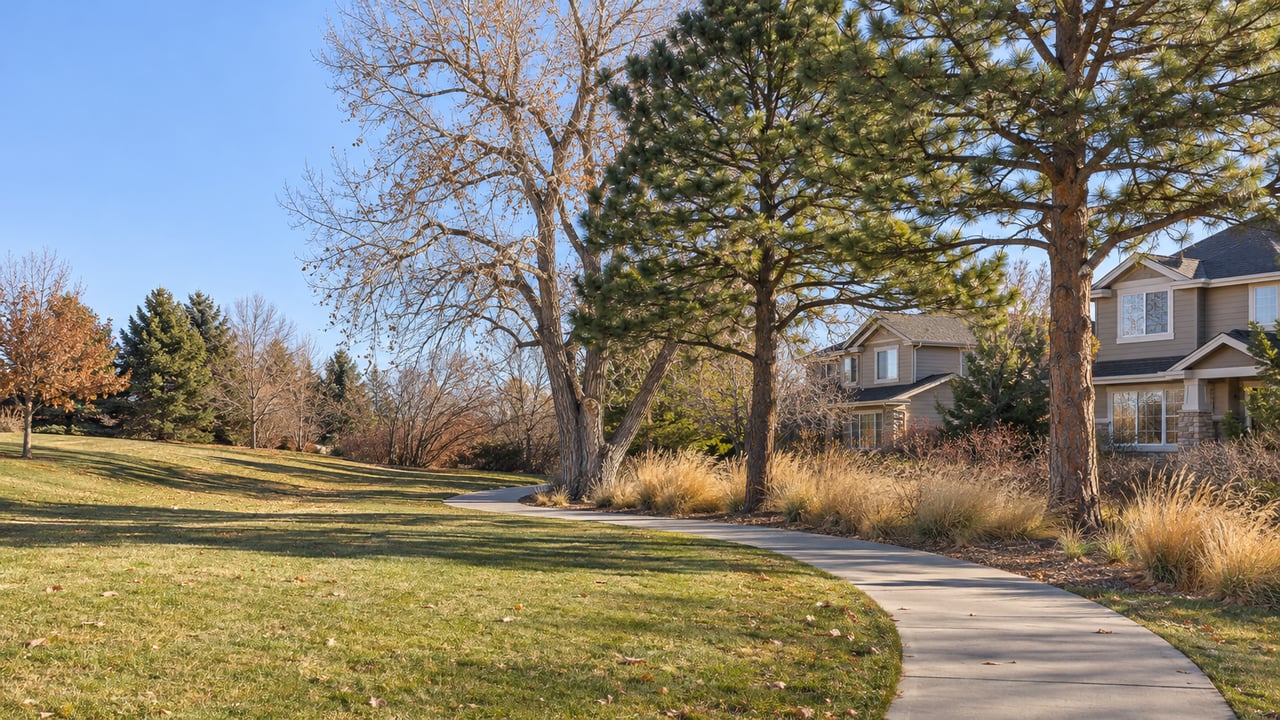
Outdoor access is a major part of daily life in Highlands Ranch. The Metro District manages 26 public parks and four dog parks, while HRCA and the Metro District highlight more than 70 miles of trails, about 2,644 acres of open space in the developed community, and the 8,200-acre Backcountry Wilderness Area with 26 miles of scenic trails for HRCA members.
That scale changes how people use the neighborhood. Walking, biking, sports practices, dog outings, and casual park meetups are built into the pattern of the community.
If outdoor time matters to you, this is one of the clearest ways villages influence everyday life. Your nearest park type, trail access, and open-space connection can affect how often you actually use those amenities.
Civic Green anchors a mixed-use core
Civic Green Park is one of the clearest civic centers in Highlands Ranch. Located at 9370 Ridgeline Blvd, it includes playground space, fountains, water features, shelters, and picnic areas.
The nearby Douglas County Libraries Highlands Ranch branch overlooks Civic Green Park from its terrace and notes adjacent RTD parking plus walkability to nearby restaurants and shopping. That combination gives this area one of the strongest mixed-use patterns in the community.
If you want a more connected, errand-friendly feel, this pocket is worth close attention. It brings together park space, library access, retail, and transit in a way that many suburban areas do not.
Park types change neighborhood feel
Not every park serves the same role in Highlands Ranch. Redstone Park works more like a larger community park, with batting cages, a skate park, tennis courts, sports fields, and multiple shelters.
Foothills Park shows the neighborhood-scale version of that planning model. It includes basketball, a community garden, a playground, and a smaller shelter.
That difference matters when you compare villages. Living near a major community park can feel very different from living near a smaller local park, even if both homes are in Highlands Ranch.
Shopping follows key nodes
Highlands Ranch does not revolve around one traditional downtown. Instead, shopping and services are spread across a few major corridors and mixed-use nodes.
The strongest retail hub is the Town Center and Civic Green area. Highlands Ranch Town Center is a 289,472-square-foot retail plaza, and Town Center North is a 306,000-square-foot retail plaza, both positioned near Civic Green Park, the library, transportation, and access to C-470.
Other shopping nodes are distributed across the community. They include Village Center at Highlands Ranch at Highlands Ranch Parkway and South University Boulevard, Shops at Highland Walk at 4000 Red Cedar Dr near McArthur Ranch Road, Central Park near Park Central Drive, and Wildcat Shopping Center at Highlands Ranch Parkway and Wildcat Reserve Parkway.
For buyers, this means errands are often pocket-specific. One home may put you closer to grocery runs and dining, while another may give you faster access to trails or recreation.
Commute patterns vary by location
Commuting is another area where village location matters. C-470 and US 85 shape much of the daily traffic flow in and around Highlands Ranch.
CDOT describes C-470 as the southwestern portion of the Denver metro beltway that runs along densely populated Highlands Ranch and connects travelers from I-70 West to I-25 South. The agency also says the corridor carries more than 100,000 vehicles a day in its busiest sections.
CDOT also identified improvements along US 85 in Douglas County for the segment from Highlands Ranch Parkway to C-470, including work at Highlands Ranch Parkway, Town Center Drive, the C-470 ramps, and County Line Road. For anyone balancing commute times with home location, those road connections are a real part of daily life.
Transit access centers on select pockets
Transit in Highlands Ranch is available, but it is concentrated in a few locations rather than spread evenly across the entire community. RTD’s 402L route runs through Highlands Ranch Parkway and connects Westridge, Northridge, Eastridge, Town Center, County Line Station, and Littleton/Mineral Station.
RTD also lists park-n-ride facilities at Highlands Ranch Town Center and C-470/University Blvd. If transit access matters to your routine, it helps to compare homes based on how close they are to those specific nodes.
This is another reason the villages shape daily life so clearly. Two homes may be only a few miles apart, but one may fit a transit-based commute far better than the other.
What buyers should compare first
If you are choosing between parts of Highlands Ranch, start with the features that affect your routine most often. In many cases, the fastest way to narrow your options is to compare the nearby rec center, the closest park type, and the most direct shopping or commute corridor.
You should also remember that Highlands Ranch is not one uniform market. With 94 delegate districts and multiple sub-associations, two homes in the same community can come with different amenities, maintenance expectations, and fee structures.
School access is also part of the original plan. HRCA says Highlands Ranch includes 19 elementary schools, 4 middle schools, and 5 high schools, which shows how closely daily services were woven into the community layout.
Why local guidance helps in Highlands Ranch
On the surface, Highlands Ranch can look straightforward because it is so well planned. In practice, that planning created layers of choice, and those layers can have a big impact on your lifestyle, resale priorities, and home search strategy.
That is why it helps to work with someone who understands how the villages function beyond the map. When you know which pocket fits your routines, your home search becomes clearer and more focused.
If you are thinking about buying or selling in Highlands Ranch, Tiffany Alexander can help you compare village-level lifestyle differences and make a confident plan for your next move.
FAQs
How do Highlands Ranch villages affect daily life?
- The villages affect your routine through nearby rec centers, park types, shopping nodes, trail access, and commute options.
What are the four main Highlands Ranch villages?
- The four main villages are Eastridge, Westridge, Northridge, and Southridge.
Is Highlands Ranch one uniform neighborhood market?
- No. Highlands Ranch includes 94 delegate districts and multiple sub-associations, so rules, fees, amenities, and maintenance expectations can vary by area.
Which Highlands Ranch area feels most walkable for errands?
- The Town Center and Civic Green area has the clearest mixed-use pattern, with retail, park space, library access, and nearby transit amenities.
What outdoor amenities are available in Highlands Ranch?
- Highlands Ranch includes 26 public parks, four dog parks, more than 70 miles of trails, about 2,644 acres of open space in the developed community, and access to the 8,200-acre Backcountry Wilderness Area for HRCA members.
What should you compare when buying in Highlands Ranch?
- Start by comparing the nearest rec center, the closest park type, nearby shopping and service nodes, and the most direct commute or transit access for your routine.